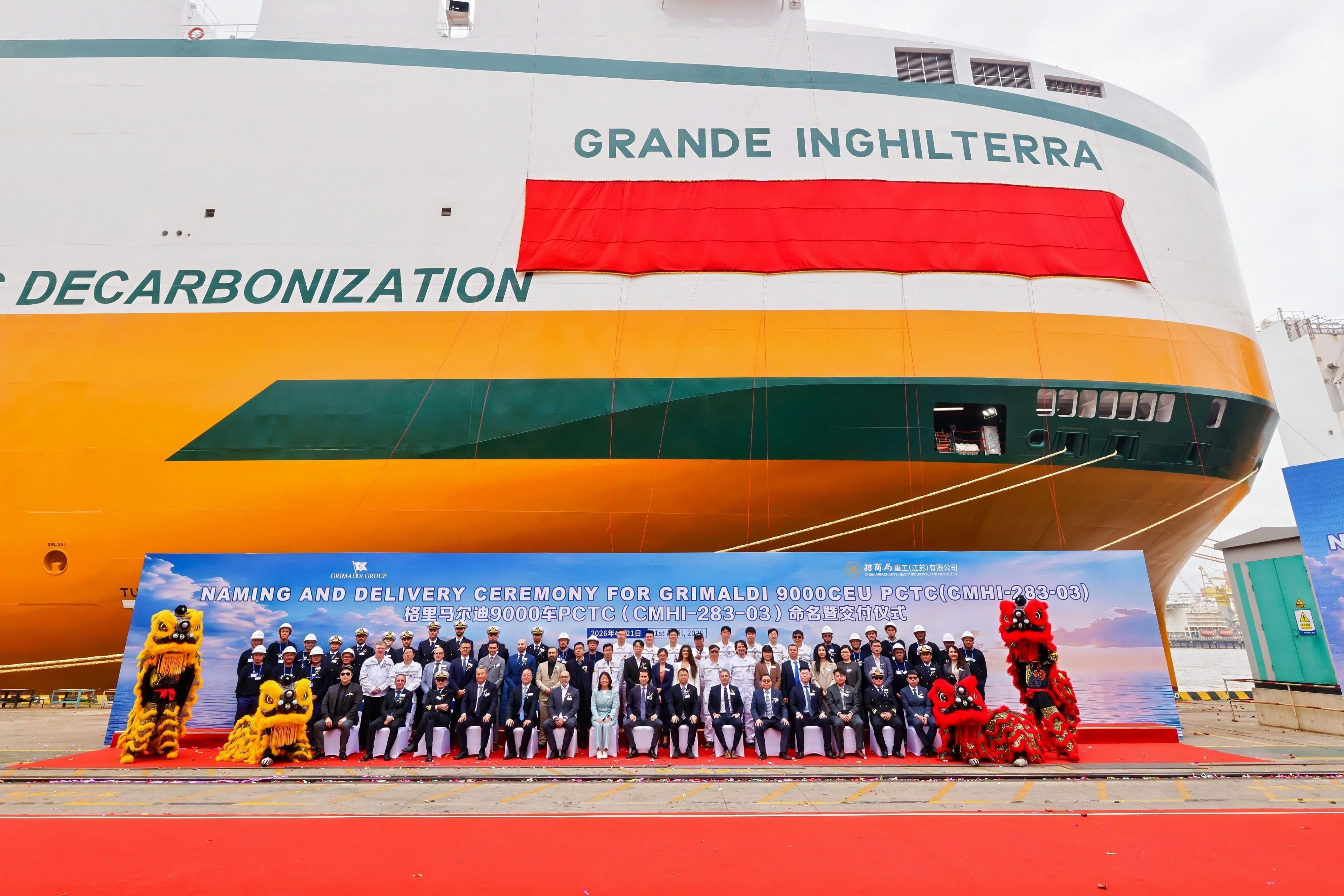

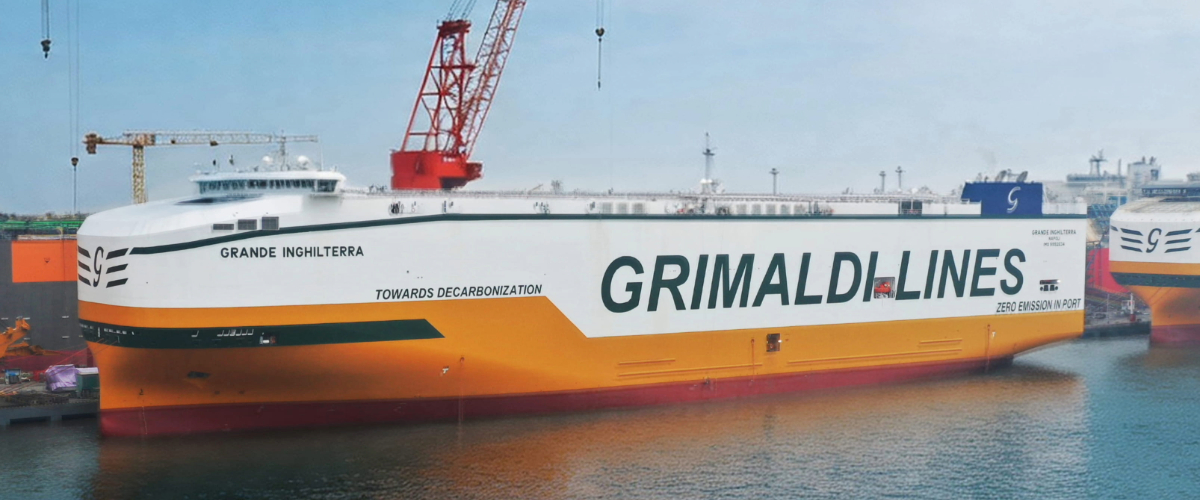
Another car carrier for Grimaldi: the Grande Inghilterra named and delivered
Ceremony in Shanghai marks the entry into the
Group’s fleet of the eleventh ammonia-ready vessel, now set for its maiden
voyage to South America and Northern Europe.
Naples, 22 April 2026: The naming and delivery ceremony of the Grande
Inghilterra was held yesterday in Shanghai. Commissioned from China
Merchants Heavy Industries Jiangsu, this is the eleventh ammonia-ready PCTC
(Pure Car & Truck Carrier) for the Grimaldi Group, meaning she is
designed for future conversion to ammonia as a carbon-free alternative
fuel.
Like her sister vessels already in service – Grande Shanghai, Grande
Svezia and Grande Michigan – the new unit stands out for her high
cargo capacity and reduced environmental impact, achieved through innovative
design and numerous advanced technological solutions installed on board.
Across her 14 decks, she can transport both electric vehicles and
those powered by fossil fuels, with a maximum capacity of 9,000 CEU (Car
Equivalent Units).
Thanks to the many green technologies adopted on board – including solar
panels, mega lithium batteries, and cold ironing readiness – the Grande
Inghilterra can reduce fuel consumption by 50% compared to
previous-generation car carrier vessels.
The ship’s name pays tribute to England, where the Grimaldi Group has
been active for around 70 years. Today, this presence is reflected not only in
regular maritime services – operated under the Grimaldi Lines, Finnlines, and
Atlantic Container Line brands – linking major English ports with those on five
continents, but also in a well-established network of local offices and
agencies.
Among those attending the naming ceremony were Mei Zhonghua,
Chairman and General Manager of CMHI, and Luigi Pacella Grimaldi,
Automotive Intercontinental Director of the Grimaldi Group.
A delegation from BAIC Foton International, a Chinese manufacturer
specializing in commercial vehicles, pick-up trucks and buses, also took part
in the event. The company relies on the Grimaldi Group as a strategic logistics
partner for exports to Africa, the Persian Gulf and the Mediterranean. As a
testament to an increasingly strong partnership, the role of godmother of the Grande
Inghilterra was entrusted to Wang Qiuxiang, Vice President of
R&D at BAIC Foton International.
“Investing in the construction of cutting-edge vessels like the
Grande Inghilterra means making a concrete contribution to the energy
transition of maritime transport, while also meeting our customers’ needs with
increasingly high-quality services,” said Emanuele Grimaldi,
Managing Director of the Grimaldi Group. “This is how we intend to continue
supporting global logistics chains: by constantly raising our standards in
terms of efficiency and sustainability.”
The Grande Inghilterra is already ready for her maiden
voyage: carrying 6,500 cars and 800 linear meters of other rolling cargo
(buses, trucks, industrial machinery), she will depart in the coming days from
Taicang (China) bound for Suape (Brazil) and Antwerp (Belgium).
Main technologies on board the Grande Inghilterra
With length of 220 metres and beam of 38 metres, the Grande
Inghilterra has a gross tonnage of 93,145 tonnes and a cruising speed
of 18 knots.
The Ammonia Ready notation issued by the Italian Shipping Register
(RINA) certifies that she can be converted to operate on ammonia as a zero
carbon-emission alternative fuel.
Built to the highest sustainability and comfort standards, the Grande
Inghilterra has also been awarded Green Plus, Green Star 3, Comfort
Vibration and Comfort Noise Port class notations.
The vessel is equipped with mega lithium batteries with a total
capacity of 5 MWh and cold ironing
capability, allowing her to draw electricity directly from shore where
facilities are available. Both systems allow her to achieve zero
emissions while in port.
She incorporates the most advanced energy-efficiency technologies,
including 2,500 square metres of solar panels, silicon-based hull coatings to
reduce resistance, and smart systems for optimising ventilation and air
conditioning. Her electronically controlled engine features an
exhaust gas cleaning system to reduce sulphur oxide (SOx) and particulate
matter (PM) emissions, and selective catalytic reduction to limit nitrogen
oxide (NOx) emissions below TIER III levels.
Additional
innovations to minimize environmental impact include an Air Lubrication System,
an optimized hull design, and an innovative gate rudder – installed for
the first time on PCTC vessels – consisting of two foil-shaped blades
positioned on either side of the propeller, enhancing both propulsion
efficiency and manoeuvrability.