

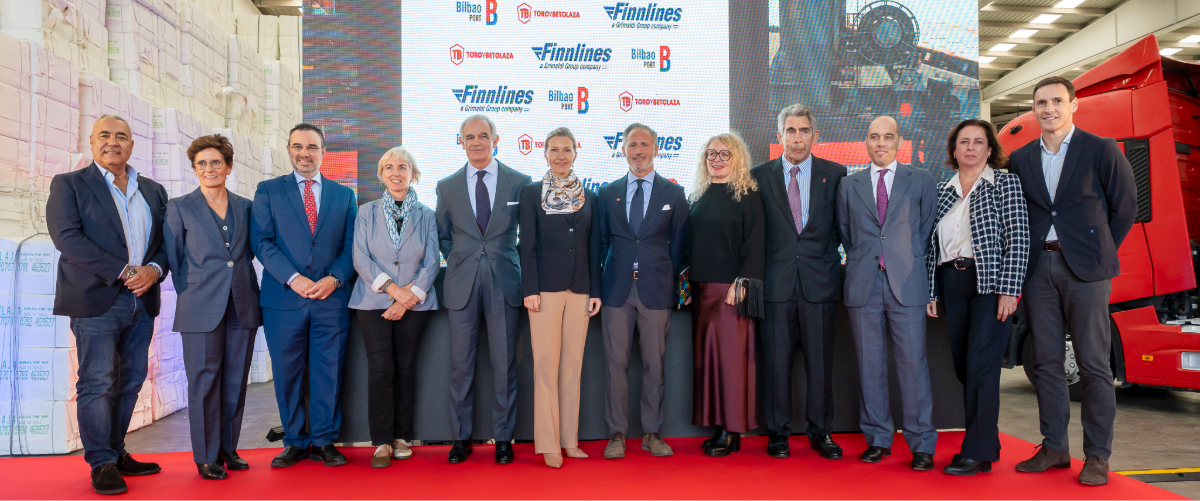
Finnlines presents its direct Gdynia connection in Bilbao
The recent
addition to Finnlines’ weekly North Sea & Biscay ro-ro service of a call at
Gdynia has been warmly welcomed both by the Grimaldi Group company’s customers and
by the port communities involved. Thanks to this enhancement, the route now
connects Poland not only to Northern Europe but also to the Group’s entire
global network, which includes the Far East, Middle East, Mediterranean, West
Africa, plus North and South America.
This
important development was presented in Bilbao on 10 October during an event
attended, among others, by Ivan Jiménez Aira, President of the Port
Authority of Bilbao, and Monika Krzepkowska, Ambassador of the Republic
of Poland to Spain.
Finnlines
Line Manager Blasco Majorana underlined how the expansion of this route
“strengthens the links between Northern and Western Europe” and “opens
up new opportunities for more efficient and sustainable freight transport,
offering a practical and advantageous intermodal alternative to road transport
for goods to and from Poland, with origin or destination in Belgium, France,
the United Kingdom, Spain and Finland.”
The
connection, provided by hybrid Finneco-class vessels, allows the transport of
rolling freight, breakbulk, containers, cars and special cargo, with one of the
lowest carbon footprints on the market.
As part of
the service upgrade, during the summer Finnlines also introduced new 80-foot (approximately
25-metre) mafi trailers with integrated rails, specifically designed to
facilitate the efficient and flexible transport of non-standardized cargo such
as trains and wagons.
As Majorana
put it, “This way Finnlines reaffirms its commitment to developing sustainable
solutions, promoting innovation and delivering reliable logistics services.”
Meanwhile, Gorka
Zabala, General Director of Consignaciones Toro y Betolaza — the company
representing Finnlines in Bilbao — emphasized that this is “a highly
significant step for the European logistics chain. The new service enhances the
value of the next-generation Finneco hybrid vessels, which can reduce CO2 emissions
by up to 90%, efficiently transporting rolling cargo (cars, vans, trucks,
etc.), project cargo, containers and a wide variety of goods. We’re talking
about a future that is already here: more sustainable, innovative and
competitive maritime transport.”
“Once
again, Toro y Betolaza confirms its commitment in this field and reiterates the
way our efforts translate into concrete actions: investments in
state-of-the-art equipment, certification, international sustainability awards
and participation in energy innovation projects,” Zabala concluded.
For her
part, Monika Krzepkowska highlighted the strategic importance of “a modern
maritime link between Gdynia and Bilbao, between Poland and Spain, which
effectively connects the extremes of Europe. Today, thanks to its modernization
and European transport corridors, Poland’s second-largest port continues to
serve as a key connection point between the Baltic and the Atlantic. For this
reason, the route represents much more than a mere logistical link: it’s a
commitment to sustainable and environmentally friendly transport, to an
integrated economy and to a truly interconnected Europe, where distances are
shortened and opportunities multiplied.”
Finally,
Ivan Jiménez Aira stressed that “this ro-ro connection with Poland constitutes
a great opportunity for companies wishing to expand their presence in Central
European markets, allowing operators to diversify their routes. At the same
time, it offers a fast and efficient alternative to attract freight traffic
currently transported by road.”
“With
this strategic move,” President Jiménez Aira concluded, “the Grimaldi
Group and Finnlines, with the support of Consignaciones Toro y Betolaza, have strengthened
the role of Bilbao as a key port for Atlantic markets, offering integrated
solutions for companies operating along the Spain–Eastern Europe corridor.”