

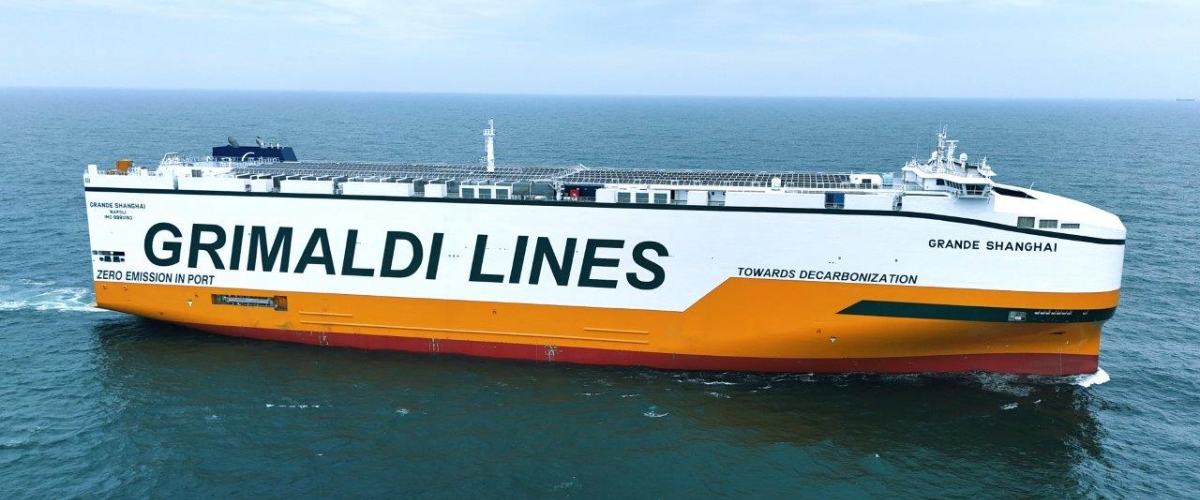
The Grimaldi Group takes delivery of the Grande Shanghai
Among
the main features of this innovative car carrier are her 9,000 CEU capacity,
halved fuel consumption and Ammonia Ready class notation.
Naples,
27 August 2025:
This morning, the Grimaldi Group took delivery of the Grande Shanghai,
the first of ten next-generation PCTC (Pure Car & Truck Carrier) units
commissioned from China Merchants Heavy Industries Jiangsu. Of these, the first
five units can carry 9,000 CEU (Car Equivalent Units), while the
following five will offer an even higher capacity of up to 9,800 CEU.
Following
the Grande Tianjin, delivered in early August, the Grande Shanghai
is the second Ammonia Ready unit in the Grimaldi fleet. This
technological gem combines high cargo capacity with eco-sustainability, reducing
fuel consumption by 50% compared to previous-generation car carriers.
The design
of the Grande Shanghai is the result of collaboration between the
Grimaldi Group and the naval design and architecture firm Knud E. Hansen. The
vessel is 220 meters long and 38 meters wide, has a gross tonnage of 91,611
tons, and a cruising speed of 18 knots. Across her 14 decks, she can transport both
electric vehicles and those powered by fossil fuels.
The Grande
Shanghai has obtained the Ammonia Ready notation from the Italian Naval
Register (RINA), certifying that she can be converted to use ammonia as a
zero-carbon alternative fuel. But this is not the only green technology
adopted onboard this innovative vessel.
Designed to
the highest standards, the ship has also earned the Green Plus, Green Star 3,
Comfort Vibration, and Comfort Noise Port class notations.
The Grande
Shanghai is equipped with mega lithium batteries with a total
capacity of 5 MWh and can also receive shore power during port stays (cold
ironing) at terminals equipped with the necessary infrastructure. Both
systems allow zero emissions during port stops.
The ship
uses all the best technologies for energy optimization: from 2,500 square
meters of solar panels to silicon-based hull coatings to reduce drag, smart
ventilation and air conditioning controls. Her electronically controlled engine
features an exhaust gas cleaning system to reduce sulphur oxide (SOx) and
particulate matter (PM) emissions, and selective catalytic reduction to limit
nitrogen oxide (NOx) emissions below TIER III levels.
Additional
innovations further minimizing her environmental impact include an Air
Lubrication System, optimized hull design, and an innovative gate rudder installed
for the first time on a PCTC vessel. This rudder, featuring two foil blades
positioned on either side of the propeller, improves propulsion efficiency and
manoeuvrability.
“The
Grimaldi Group confirms its active and strong commitment to the ecological
transition of shipping,” said Managing Director Emanuele Grimaldi. “Two
and a half years ago, when we signed the order for these ten extraordinary new
units, we decisively chose to invest in a carbon-free future by focusing on
alternative fuels such as ammonia. An investment we continue to strongly
support, as we believe that to maintain leadership in our sector, it is
necessary to offer the best sea transport services with the lowest possible
environmental impact. With cutting-edge ships like the Grande Shanghai, we will
continue to support the global automotive industry with quality, efficiency,
and sustainability.”
The Grande
Shanghai will make her maiden voyage on the East Asia – East Africa
service, launched by the Grimaldi Group last June and now on its third
departure. Loaded with 7,000 linear meters of new rolling cargo units
(including trucks, trailers, buses, tractors and agricultural machinery), the
vessel will depart from the Chinese port of Taicang in early September and will
subsequently call at Mombasa (Kenya) and Dar es Salaam (Tanzania).
In the
future, the Grande Shanghai is set to strengthen Grimaldi’s
services dedicated to vehicle transport between East Asia and Northern Europe.
The other 15 PCTC Ammonia Ready units currently under construction for the
Naples-based shipping group — scheduled for delivery between 2025 and 2027 —
will also be deployed on routes serving the Asian market.